Abstract
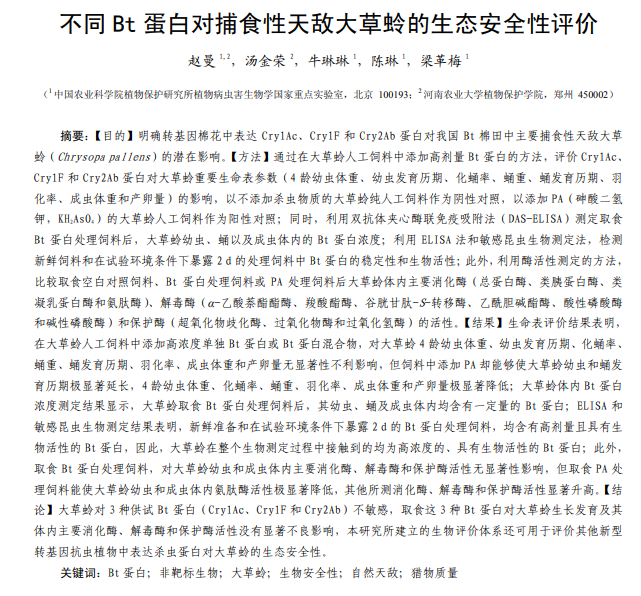
【Objective】The objective of this study is to evaluate the potential effects of Cry1Ac, Cry1F and Cry2Ab proteins, which have been transformed into Bt cotton, on Chrysopa pallens, the main predatory enemy in Bt cotton fields of China. 【Method】The effects of Cry1Ac, Cry1F and Cry2Ab proteins on the important life table parameters (weight of 4th instar larvae, developmental period of larvae, pupation rate, pupa weight, developmental period of pupae, eclosion rate, adult weight and total fecundity) of C. pallens were evaluated by the method of adding the high-dose Bt proteins in the artificial diet of C. pallens, and the pure artificial diet of C. pallens treated without insecticidal compound was used as negative control while the artificial diet of C. pallens treated with PA (KH2AsO4) was used as positive control. Meanwhile, the concentrations of Bt protein in larvae, pupae and adults of C. pallens after feeding with Bt protein-treated diet were measured by double-antibody sandwich enzyme-link immunosorbent assay (DAS-ELISA) method. The stability and bioactivity of Bt protein in the fresh prepared diet or diet that had been exposed to C. pallens for 2 days were measured by ELISA and sensitive-insect bioassay, respectively. In addition, the main digestive enzymes (total protease, tryptase, chymotrypsin, and aminopeptidase), detoxifying enzymes (α-naphthyl acetate esterase, carboxylesterase, glutathione-S-transferase, acetylcholinesterase, acid phosphatase, and alkaline phosphatase) and antioxidant enzymes (superoxide dismutase, peroxidase, and catalase) of C. pallens after feeding on control artificial diet, Bt protein-treated diet or PA-treated diet were compared by using enzyme activity measurement method. 【Result】 The results of life table evaluation showed that there was no significant adverse effect on the weight of 4th instar larvae, developmental period of larvae, pupation rate, pupa weight, developmental period of pupae, eclosion rate, adult weight and total fecundity of C. pallens by adding Bt protein or Bt protein mixture to the artificial diet, but the addition of PA in the artificial diet extremely significant prolonged the developmental period of larvae and pupae, and extremely significant decreased the weight of 4th instar larvae, pupation rate, pupa weight, eclosion rate, adult weight and total fecundity of C. pallens. The measurement results of Bt protein concentration in C. pallens showed that there was a certain amount of Bt protein in the larvae, pupae and adults of C. pallens after feeding on Bt protein-treated diet. The ELISA and sensitive-insect bioassay measurement results indicated that both the fresh prepared diet and diet that had been exposed to C. pallens for 2 days contained high concentration of Bt protein with biological activity. Thus, C. pallens was exposed to high concentration of Bt protein with biological activity in the whole process of bioassay. Furthermore, ingestion of Bt protein-treated diet had no significant effect on the activities of digestive enzymes, detoxifying enzymes and antioxidant enzymes in C. pallens larvae and adults, but ingestion of PA-treated diet remarkably decreased the activity of aminopeptidase in C. pallens larvae and adults and increased the activities of other testing enzymes of C. pallens. 【Conclusion】 C. pallens is insensitive to the three tested Bt proteins (Cry1Ac, Cry1F and Cry2Ab). Ingestion of the tested Bt proteins has no obviously detrimental effect on the development and activities of main digestive enzymes, detoxifying enzymes and antioxidant enzymes of C. pallens. The biological evaluation system established in this study can also be used to evaluate the ecological safety of other insecticidal proteins from new insect-resistant genetically modified crops to C. pallens.