Effects of different wavelengths of light on the phototactic behavior and opsin expression in Spodoptera frugiperda adults
Abstract
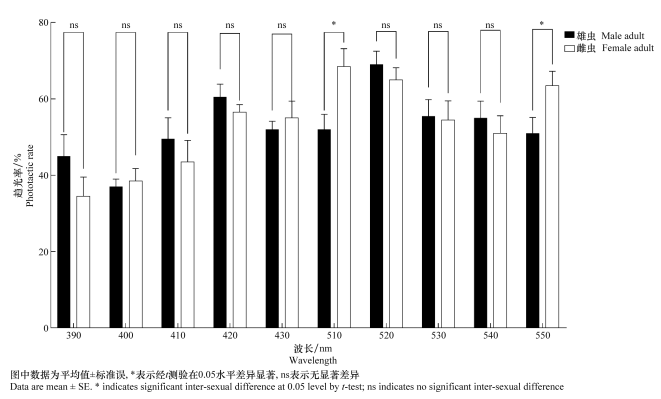
In order to improve the light-trapping efficacy on Spodoptera frugiperda in the field, the phototactic behavior of male and female moths to 10 light sources with different wavelengths (390-550 nm) and the effect of light stimulation on the expression levels of four opsin genes of S. frugiperda were tested in the laboratory. The results showed that there were significant differences in the phototactic rate of both male and female moths to 10 light sources. The female moths showed relatively higher phototaxis to 510 nm, 520 nm and 550 nm (green light), with a phototactic rate of 68.5%, 65.0% and 63.5%, respectively. The male moths showed relatively higher phototaxis to 520 nm (green light) and 420 nm (purple light), with a phototactic rate of 69.0% and 60.5%, respectively. For the 10 different light wavelengths tested, there were significant inter-sexual differences in the phototaxis of S. frugiperda moths to 510 nm and 550 nm, but no significant differences to the other wavelengths. The phototaxis of moths at different day-ages to the stimulation of 520 nm light was tested, and the results showed that both female and male moths had the highest phototactic rate at the age of 3 day-old (female: 65.0%; male: 69.0%) and 5-day old (female: 59.1%; male: 61.4%), while the lowest at the age of 1-day old (female: 41.4%; male: 24.1%). When male moths were stimulated by 520 nm light for 20 min, the relative expression level of ultraviolet-sensitive opsin (UV-opsin) gene increased significantly, which was 3.61 times of the control. However, the relative expression level of the other tested opsin genes had no significant difference from the control group, including the long-wavelength-sensitive opsin 1 (LW-opsin1), the long-wavelength-sensitive opsin 2 (LW-opsin2) and the blue-sensitive opsin (B-opsin) genes. When female moths were stimulated by 520 nm light for 20 min, the relative expression level of the four tested opsin genes had no significant differences from the control. In conclusion, S. frugiperda moths had higher sensitivity to green and purple lights, and the highest phototaxis occurred at the age of 3-day and 5-day old after emergence; meanwhile, the changes of expression level of opsin genes might be the key factor affecting the response of S. frugiperda to different light stimulations.